
Most sovereign AI plans are measured in servers and contracts. What companies are trying to protect is their knowledge.
What sovereign AI is for.
Companies are defining sovereign AI by where their data goes and whose machines process it. It’s an expensive definition, and it misses the thing they’re trying to protect.
What a general counsel or CIO needs to protect is the company’s knowledge: its contracts, case history, engineering know-how, trade secrets, and the judgment it spent decades building. Most of that is intellectual property (IP), and some of it is the company’s most valuable IP. The question is who gets to learn from it, and whether it could walk out the door inside someone else’s AI model.
Two roads, one bill.
Right now, most companies pick one of two roads.
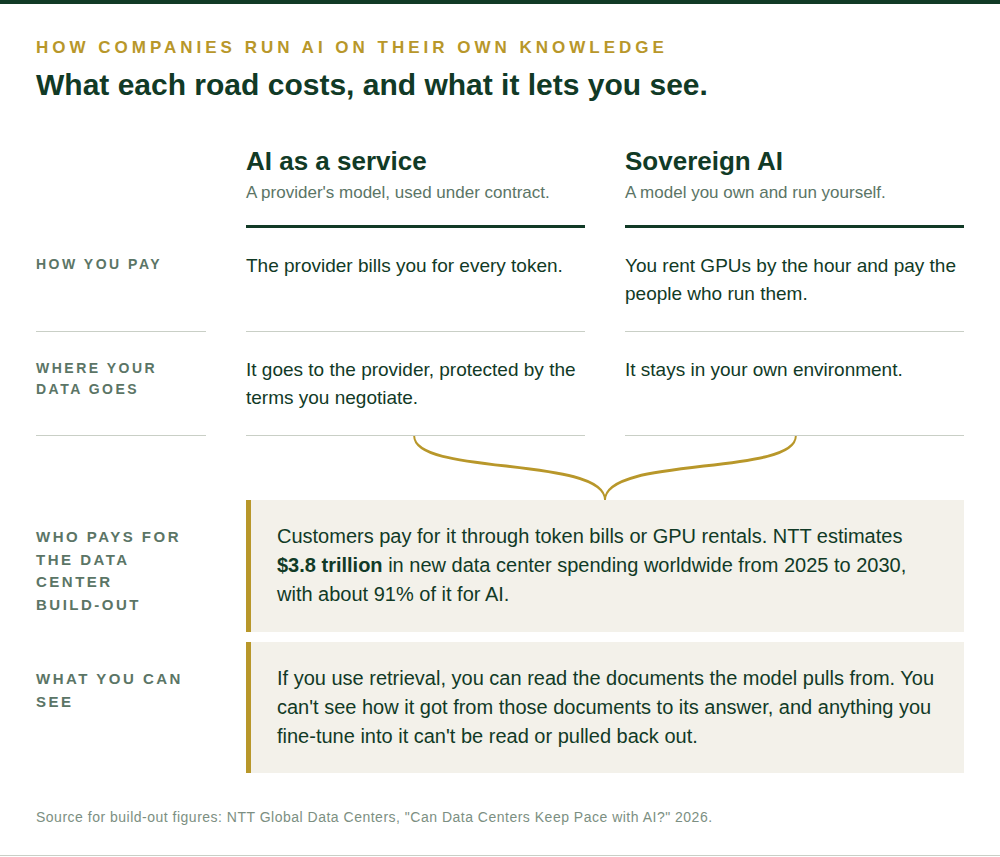
The first is AI as a service. You use a provider’s model, pay by the token, and negotiate the protections, like zero data retention and a promise not to train on your inputs. Palantir’s paper “Institutional Sovereignty in the Age of AI,” which we wrote about in August, lays out fifteen of these defenses and admits how much they depend on bargaining power. Zero retention “must be negotiated with model providers,” and a provider’s SOC 2 report “does not say anything about whether and how your data may have entered a training pipeline.”
The second is sovereign AI, a model you own and run yourself. Usually that’s an open model, running on your own hardware or on GPUs rented from a cloud provider. Even when the hardware is rented, the model and your data stay inside your own environment, and nobody else’s model learns from it. You pay for computing time by the hour instead of by the token, plus the people it takes to run it.
Either way, the bill runs through a data center. NTT’s 2026 outlook, “Can Data Centers Keep Pace with AI?“, estimates $3.8 trillion in new data center spending worldwide between 2025 and 2030, with about 91% of it going to AI. According to analysts the report cites, the hyperscalers issued a record $128 billion in investment-grade debt in 2025 to pay for it, and their free cash flow fell to its lowest level since 2014.
That investment has to be paid back, and customers are the ones who will pay it. Per-token prices have been falling, but companies are using far more of them as AI moves into everyday work, so the total bill keeps growing. The hourly rate for rented GPUs must cover the same costs.
What neither road shows you.
Sovereign AI keeps your data in your own environment. It doesn’t let you see inside the model, and neither does an AI service contract.
Every large language model, open or closed, stores what it knows in its weights, billions of numbers nobody can read. The model learned most of it from data you didn’t choose.
Most companies don’t retrain a model on their own documents. They use retrieval, often called RAG: the documents stay in a library the company controls, and the model pulls the relevant pages each time someone asks a question. The files stay readable. How the model got from those pages to its answer doesn’t. You can’t tell which parts of an answer came from your documents and which came from the model’s training, and when it cites a source, the model usually decides which source supports which sentence.
Companies that do fine-tune a model on their documents are in a tougher spot. Their know-how gets folded into the weights, where nobody can read it or pull it back out.
In both cases, the reasoning about a company’s most valuable IP happens somewhere nobody can inspect.
Knowledge you can open and read.
The clearest evidence comes from law, because lawyers check.
Franklin Discovery™ by entigenlogic® stores what it learns from your documents, IP included, in a form you can read. It’s a hybrid. A large language model handles language, which is what those models do best. Finding and reasoning run on a map of concepts entigenlogic built over many years, where each idea is written down and linked to the ideas it relates to. Your documents are read into that map, so you can open it and correct what it knows about your business. Every answer shows why Franklin Discovery surfaced it and its source.
It’s lighter on the bill, too. Franklin Discovery works more like specialized AI than general-purpose AI, because it answers from a bounded set of documents, your own, instead of everything a large model was trained on. Much of answering a question happens by following connections in the concept map, which takes far less compute than running every step through a large model. That means fewer tokens on the first road and fewer rented GPUs on the second.
Getting sovereignty right.
The data center build-out will keep passing its costs on to customers, through token bills or GPU rentals. The companies that come out ahead will be the ones that can understand what their AI knows about their business.