
The AI pervasive in every headline is only half of the story. Using generative AI alone is like making a decision with half your brain.
Two ways AI adds value to a business.
Generative AI is the kind most people have used: the chat tools and writing assistants of the past few years. It’s called generative because it generates. It produces new text one word at a time, predicting what’s most likely to come next based on patterns it learned from an enormous amount of writing. That’s what lets it draft a memo or answer a question in plain English in seconds.
It keeps no file of facts. It has a feel for what usually follows what, which is why its answers read so well, and why they can be wrong in hard-to-spot ways.
Deciding with half a brain.
When a decision matters, you switch between two kinds of thinking without noticing. The first is fast. You skim the contract, get the gist, and an answer comes to mind before you finish reading. The second is slow. You remember what the client said in March, notice it doesn’t match what they’re saying now, and go back to check. If someone asks how you got there, you can walk them through it.
Generative AI is the fast kind. It recognizes patterns and produces the likeliest response, which is the first half of that decision and none of the second.
So imagine making the decision with the slow half switched off. You’d still get the gist of the contract and a first answer that sounds right. You’d miss that it contradicts what the client said in March, because the fast half never makes that connection. You wouldn’t notice when the answer isn’t in the material because nothing stops you from looking. And if someone asked how you got there, you’d have nothing to show them.
Generative AI on its own gives you a fluent first answer, with nothing behind it to connect the facts or explain the result.
Two systems in the brain.
Psychologist Daniel Kahneman named those two kinds of thinking. System 1 is the fast one. It’s automatic, and it handles most of the day without effort. System 2 is the slow one. It’s deliberate, and it takes over when you have to work through something step by step.
Decades ago, AI research divided into two camps that match those two systems. Generative AI is built on neural networks, which learn patterns from examples. They’re the field’s System 1. Symbolic AI is its System 2. It stores knowledge explicitly as concepts and the rules connecting them, and reasons over that knowledge step by step, so you can trace every conclusion back to what produced it.
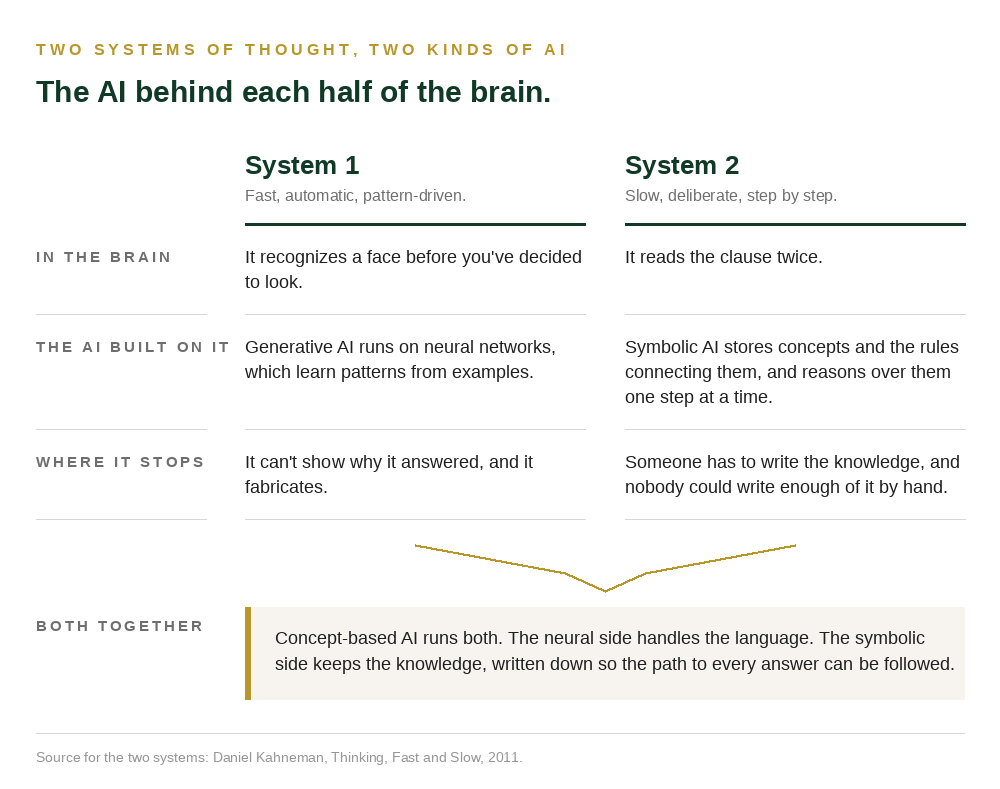
Symbolic AI had its own problem. The reasoning can be followed line by line, but someone has to write the knowledge it reasons over, and in the 1980s nobody could write enough of it by hand. The field moved on to statistics, which is where generative AI came from.
Running both.
Concept-based AI uses both kinds. The neural side reads the language. The symbolic side keeps the knowledge written down so you can follow the path to every answer. In one NeurIPS study, adding a knowledge graph to retrieval improved multi-hop question answering by up to 20 percent.
The knowledge still has to come from somewhere. Franklin Discovery™ by entigenlogic® runs on a concept map the team built over many years. It covers what words mean, which meanings overlap, and how ideas connect, and it ships with the system. Your documents are read into that map instead of being used to build one.
A large language model handles the language. Finding and reasoning run on the map. Every answer carries the source behind it, and when the answer isn’t in your documents, Franklin Discovery says so.
The answer you confidently act on.
Most of what AI does in a workday ends in something somebody signs. The contract gets countersigned, or the number goes into the proposal. Whoever signs is the one accountable, and an answer that can’t show where it came from leaves that person doing the second half of the thinking by hand, rereading the sources and hoping nothing got made up.
With both halves running, the answer arrives with its reasoning attached. You can see which documents it came from and why it surfaced them, and when your material doesn’t support an answer, it says so. By the time the answer reaches you, the slow half of the thinking is already done.
You’re not hoping it’s right. You can check that it is, and you can put your name on it.
The full argument is in our technical overview, The Missing Half of the Answer.