
Everyone says to give the model more context, and you’ll get a better answer. Why is no one asking why a machine that seems to know everything needs context in the first place?
Every AI vendor is talking about context. In plain terms, context is the material you give a model along with your question: the documents, the records, the background it needs to answer well. Models can now read more of it at once; they can search the internet for it themselves, and “context engineering” has replaced prompt engineering as the thing consultants sell. The advice for getting better answers from a model is always some version of “give it more context,” and it’s right, as far as it goes.
Here’s what that advice leaves out. Context is something you add afterward. The answer is only as good as what you hand the model. Everything it knows was fixed the day training stopped, stored as patterns across billions of weights, and there’s no practical way to open it up and add your contracts, your case files, or your clinical records. So, you hand them over at question time, in the prompt, and the model reads them the way you’d skim a briefing on the way into a meeting. When the conversation ends, it’s forgotten. Next question, you hand it over again.
That’s the workaround the whole industry has settled on. It matters because two AI systems can read the same document and get to an answer by completely different routes, and the route decides whether the answer can be checked and whether you’d get the same one tomorrow. If you’re buying AI for work where a poor answer costs something, the route matters more than the model’s name.
One word, nine meanings.
The clearest way to see the difference is a single word.
Read this paragraph once. Emma had run the budget numbers and realized that her run for city council was, in the long run, going to run into trouble. The campaign funds were going to run out and run down her campaign before they could run new advertising. She decided to go for a run and think about how to run her campaign better.
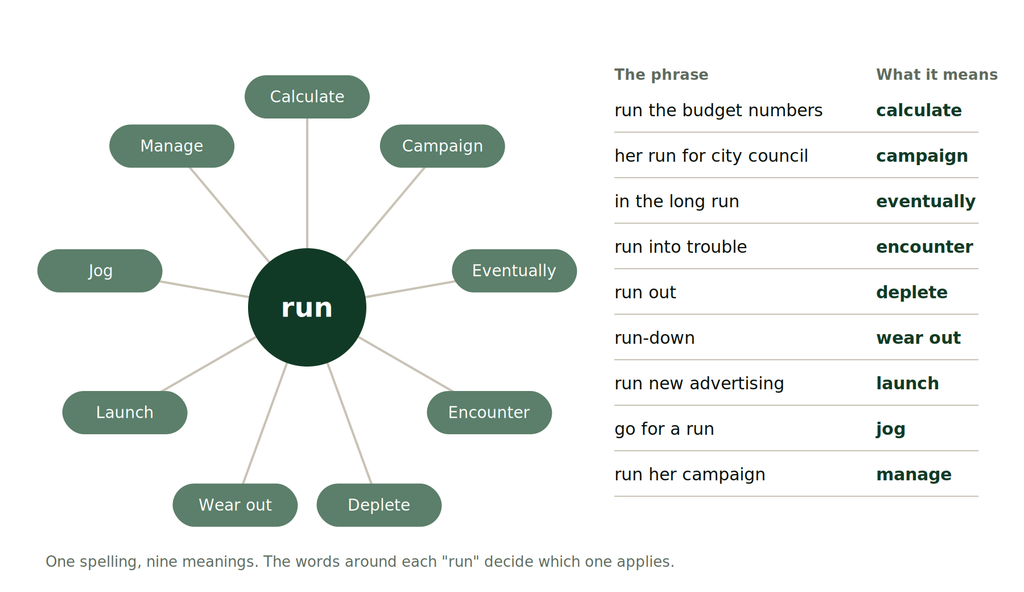
Nine uses of “run,” nine different meanings: to calculate, to campaign, eventually, to encounter, to deplete, to wear out, to launch, to jog, and to manage. You didn’t stumble once. The words around each “run” told you which one it was before you had time to wonder.
“Run” is an extreme case. When the Oxford English Dictionary revised its entry for the third edition, lexicographer Peter Gilliver counted 645 distinct senses for the verb alone, which made it the longest entry in the dictionary.1 Most words carry fewer, but almost every common word carries more than one. Linguists call this polysemy: a single word form associated with two or more related senses.2 It’s the normal condition of language, and people are so good at it that we forget it’s a problem to be solved at all.
It’s a problem for machines. How an AI system resolves it, and how reliably, is one of the more useful things to know before you trust it with anything critical.
How a language model decides what “run” means.
A large language model doesn’t look “run” up. It predicts.
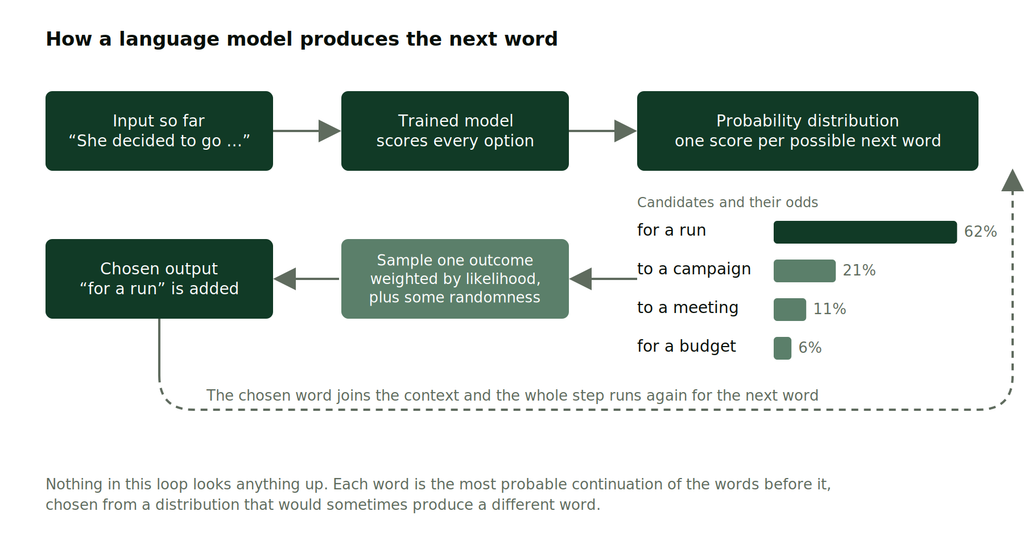
The process is the same for every word it produces. The model reads everything in front of it, the question, the documents, its own answer so far, and treats that as context. Then it considers every possible next word it knows and assigns each one a probability, based on patterns learned from an enormous amount of training text. It picks one, usually a likely one but not always the single most likely, because a little randomness keeps its answers from being identical every time. The chosen word is added to the context, and the whole thing runs again for the next word.
Take Emma’s last sentence, cut off after “She decided to go.” The model scores its options. “For a run” might come out at 62 percent. “To a meeting” and “for a budget” get smaller shares. It samples from that distribution, appends “for a run,” and moves on to predict “and think.”
Inside the model, “run” isn’t filed as nine entries. It’s a position in a mathematical space, and the surrounding words push that position around. Research on this goes back to earlier, static word embeddings, in which a 2018 study showed that the multiple senses of a polysemous word reside “in linear superposition” within a single vector.3 Later models let context move the vector, and they move it a lot: in models like BERT and GPT-2, less than five percent of the variation in a word’s representation is explained by anything fixed about the word itself.4 The word is one thing with soft edges, and context nudges it toward whichever sense fits.
And it works. On the standard English word-sense benchmark, GPT-4o scores about 82 F1, in the same range as the specialized disambiguation systems built for that one task.5 Where the models fall short is on the hard cases. On the difficult subset of the same benchmark, GPT-4o’s score drops to the mid-40s, and the failures cluster around rare senses and closely related meanings of the same word.5 A human expert scored 91 on a sample where GPT-4o scored 82.5 A separate 2025 study of open-weight models found the same shape: roughly 75 percent accuracy at picking the right sense from a list, and moving from a 70-billion-parameter model to a 405-billion-parameter one added almost nothing.6 The models are good at common sense, less good at uncommon ones, and making the models bigger has stopped helping much.
So, a language model reads Emma’s paragraph correctly most of the time. Getting it right isn’t the issue. How it got there is.
The same question asked twice.
Ask a person what “run” means in “run the budget numbers,” and you’ll get the same answer tomorrow. Ask a language model the same question twice and you might not.
Most people assume the variation comes from the randomness in sampling, and that setting the model’s temperature to zero, which tells it to always pick the top-scoring word, makes the output deterministic. It doesn’t. A 2024 study ran five models, including GPT-4o, on eight benchmark tasks, ten times each, at temperature zero with a fixed seed. Accuracy varied by up to 15 percentage points between runs of the same task on the same model. Across several tasks, GPT-4o never produced the same string twice in 10 tries. The authors’ conclusion: “none of the LLMs consistently delivers repeatable accuracy across all tasks, much less identical output strings.”7
Our favorite demonstration comes from Thinking Machines Lab, which in 2025 sent one prompt to an open model 1,000 times at temperature zero and got back 80 different answers. All 1,000 agreed that Richard Feynman was born on May 11, 1918, in New York. Then 992 of them wrote “Queens, New York” and eight wrote “New York City.” The model didn’t know anything different on those eight runs. What changed was the arithmetic. Inference servers batch requests together; the batch size changes with load, and floating-point math can yield slightly different results depending on the order of operations. The rounding differences pile up through the layers until, somewhere around the hundredth word, two runs pick different tokens.8 It’s fixable, and in their tests the fix made inference about twice as slow.
None of this makes a model’s answer wrong. It makes the answer a draw. When the model says “run” means calculate, that’s the most likely reading, produced by a process that would sometimes say something else. There’s an older way to answer the same question, and it starts from the opposite premise: what if the context were built in?
Notes
1. Simon Winchester, interviewed by Neal Conan, “Has ‘Run’ Run Amok? It Has 645 Meanings … So Far,” Talk of the Nation, NPR, May 30, 2011. Winchester reports the count made by OED associate editor Peter Gilliver for the verb “run” during the third-edition revision. https://www.npr.org/2011/05/30/136796448/has-run-run-amok-it-has-645-meanings-so-far
2. Ingrid Lossius Falkum, “Polysemy,” Oxford Research Encyclopedia of Linguistics, Oxford University Press, 2015. DOI 10.1093/acrefore/9780199384655.013.325.
3. Sanjeev Arora, Yuanzhi Li, Yingyu Liang, Tengyu Ma, and Andrej Risteski, “Linear Algebraic Structure of Word Senses, with Applications to Polysemy,” Transactions of the Association for Computational Linguistics, vol. 6, 2018. https://arxiv.org/abs/1601.03764
4. Kawin Ethayarajh, “How Contextual are Contextualized Word Representations? Comparing the Geometry of BERT, ELMo, and GPT-2 Embeddings,” EMNLP 2019. https://arxiv.org/abs/1909.00512
5. Domenico Meconi, Simone Stirpe, Federico Martelli, Leonardo Lavalle, and Roberto Navigli, “Do Large Language Models Understand Word Senses?,” EMNLP 2025. GPT-4o: 82.3 F1 zero-shot on the main English WSD test set, against 83.0 for the specialized ConSeC system. https://arxiv.org/abs/2509.13905
6. Pierpaolo Basile, Lucia Siciliani, Elena Musacchio, and Giovanni Semeraro, “Exploring the Word Sense Disambiguation Capabilities of Large Language Models,” arXiv:2503.08662, March 2025. Zero-shot multiple-choice WSD accuracy: Llama 3.1 70B-Instruct .752, Llama 3.1 405B-Instruct .753. https://arxiv.org/abs/2503.08662
7. Berk Atil, Sarp Aykent, Alexa Chittams, et al., “Non-Determinism of ‘Deterministic’ LLM Settings,” arXiv:2408.04667, 2024 (rev. April 2025). https://arxiv.org/abs/2408.04667
8. Horace He and Thinking Machines Lab, “Defeating Nondeterminism in LLM Inference,” September 10, 2025. Qwen3-235B, 1,000 completions at temperature 0, 80 unique. https://thinkingmachines.ai/blog/defeating-nondeterminism-in-llm-inference/