
Part two of Why Context Is King. A language model resolves the meaning of every word by guessing, very well, one word at a time. This is what happens when the system already knows what the words mean.
How a lookup decides what “run” means.
In the first part of this piece, Emma ran the budget numbers, ran for city council, and went for a run, and a language model sorted out all nine meanings of “run” by predicting the most probable one, nine times. It got them right. It would also have given a slightly different answer on another day, because a prediction is a draw from a distribution. An older approach to the same question starts from the opposite premise. What if the context were built in?
A symbolic system stores meanings as entries in a knowledge base. Each entry describes one concept and links to related concepts. “Run” as in jogging is one entry, connected to exercise and distance. “Run,” as in a campaign, is another entry, connected to elections, candidates, ballots, and votes. They share a spelling and nothing else. When the system reads Emma’s sentence, it identifies which entries the surrounding words point to, finds the concepts related to each candidate, scores those connections by relevance, and selects the meaning that fits with everything else in the sentence. It’s a lookup followed by a selection and given the same sentence and the same knowledge base, it selects the same meaning every time.
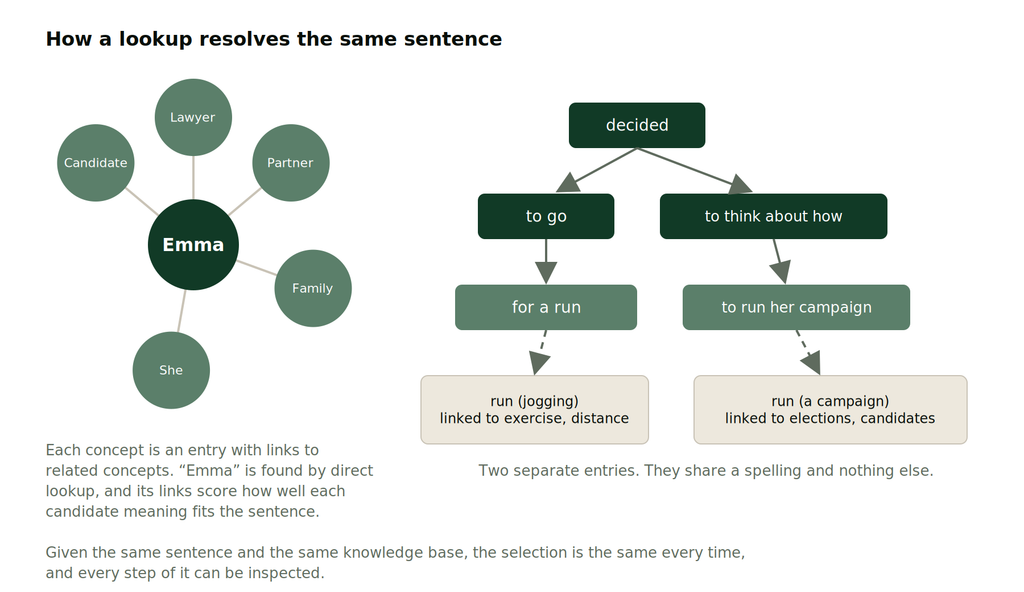
The clearest way to see the difference is a single word.
The two approaches differ in where the meaning lives. In a language model, meaning is implied by the statistics of how words appear together, and it shows up at answer time. In a symbolic system, meaning is written down ahead of time as structure, and the system consults it. Which brings us back to the word “context.” In a symbolic system, the context is built in. It’s the knowledge base.
Structure pays off even when you bolt it onto a language model rather than replacing it. When data.world asked GPT-4 questions over an enterprise insurance database, it got 16 percent of them right. Asked the same questions over a knowledge graph built from the same database, it got 54 percent.1 A survey of this research at NAACL 2024 collected similar results, including one method that raised ChatGPT’s accuracy on a reasoning task from 66.8 percent to 85.7 percent by giving it a knowledge graph to consult.2 Those are hybrids, and they aren’t the same thing as a symbolic system. The pattern across them is consistent, though: a model that can consult explicit structure gets more answers right than one relying on prediction alone.
The trade is that a symbolic system only knows what’s in its knowledge base. If a concept isn’t there, it can’t guess its way to one. Most people hear that as a limitation, and for writing a poem it is. In regulated work, it’s the whole point, because a system that can’t guess can tell you when the answer isn’t in the record. The knowledge base was built once and is still growing, and it learns the vocabulary of each organization and industry it works in as it goes.
Where the difference costs money.
The clearest evidence comes from law, because lawyers check.
In 2024, a Stanford team tested the AI research tools sold by LexisNexis and Thomson Reuters, both marketed as hallucination-free. Across more than 200 legal queries, the tools hallucinated between 17 and 33 percent of the time. Westlaw’s AI-Assisted Research produced a hallucination in roughly 1 out of 3 responses.3 Those tools use retrieval to ground the model in real case law, and they still did better than general-purpose models: an earlier study by the same group found that when asked a direct, verifiable question about a randomly selected federal case, general-purpose models hallucinated between 58 and 88 percent of the time.4
The consequences are documented. In Mata v. Avianca, a federal judge sanctioned two lawyers and their firm $5,000 for filing a brief with citations to cases that didn’t exist and that ChatGPT invented.5 That was 2023, when a case like it was still news. A database maintained by the legal researcher Damien Charlotin now tracks court and tribunal decisions worldwide in which a party relied on AI-fabricated material. As of mid-September 2026, it lists 2,041.6 In 2025, Deloitte partially refunded the Australian government for a A$440,000 report that contained a fabricated quote from a federal court judgment and citations to academic papers that don’t exist.7
Medicine shows the same failure in a different form. A 2025 study in Communications Medicine gave six language models clinical scenarios, each containing one planted false detail, such as a non-existent lab test. The models elaborated on the fake detail, treating it as real, between 50 and 82 percent of the time, depending on the model.8 Nothing in the model’s process flagged the detail as unknown, because a prediction engine doesn’t have a category for unknown. It has a category for unlikely, and it can always find a likely next word, whether it’s correct or not.
That’s the same mechanism that resolves “run.” A model that picks the most probable sense of a word will also resolve a nonexistent lab test, a fake case name, or a clause that isn’t in the contract the same way: by generating the most probable continuation. The output reads the same whether the fact was there or not. In a marketing draft, you edit it. In a court filing or a treatment plan, you need something the model can’t give you: a system that knows the difference between “the answer is this” and “the answer isn’t here.”
What this means for mission-critical work.
Once you frame the question this way, the requirements for AI in regulated and high-stakes work write themselves. The system must find the right passage in a large private record. It must show why it answered, with reasoning you can inspect rather than a generated citation. It has to say the same thing when asked the same question. And when the answer isn’t in the record, it has to say so.
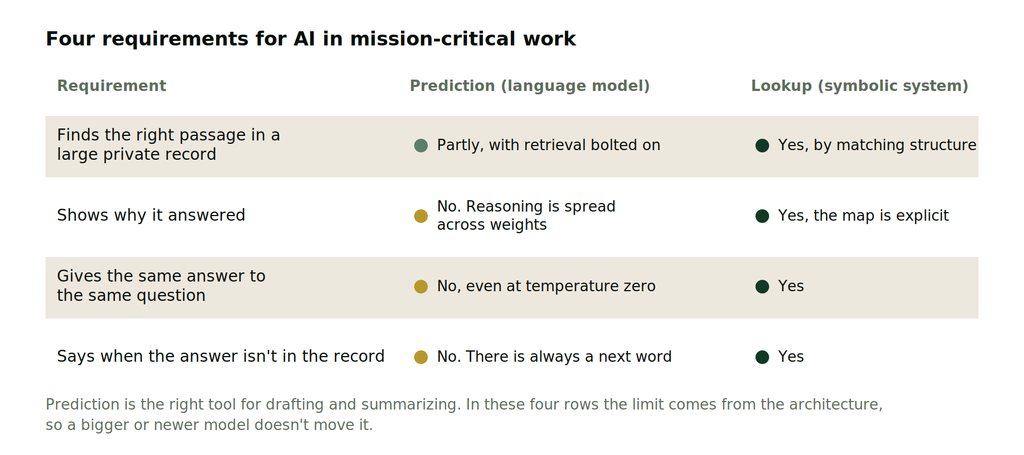
Language models can’t meet the last three because of their architecture, so a newer model won’t correct the problem. Prediction can’t stop, because there’s always a next token. It can’t explain, because the reasoning is spread across billions of weights with nothing written down. And it can’t repeat itself, for the reasons above. Retrieval tools bolted onto a model help with the first requirement and don’t change the other three, which is what the Stanford legal study measured.
Franklin Discovery™ was built on the lookup side of this divide. The symbolic approach predates deep-learning language models, and it stalled in the 1980s because every system had to be taught from scratch, one rule at a time. What changed is that in hybrid neuro-symbolic systems such as Franklin Discovery, the knowledge base is built once, ships with the system, and your documents plug into it. So you get the speed of probabilistic pattern recognition and the certainty of a context-rich symbolic system. When it reads a document, it doesn’t store the words. It resolves each word to a meaning, using a foundation ontology the team has built over many years, best described as an embedded dictionary, thesaurus, and mini encyclopedia of concepts and how they relate, and stores the resulting structure: every concept identified, every relationship between them written down. “Run” as in jogging and “run” as in a campaign go into that structure as different things, and they stay different. A question is interpreted the same way and answering it means matching structure against structure in the customer’s own record. The context is built in before anyone asks a question.
That gives you the four properties directly. The answer traces to the passages it came from, because it was found there. The reasoning is a map you can open. The same question against the same record produces the same answer. And when nothing in the record matches, the system says so instead of composing something that sounds right. The method is patented, and it runs alongside the language models: they’re good at drafting and summarizing, and Franklin Discovery provides the context. Emma’s paragraph took you a few seconds, and you never once thought about how you did it. That’s what built-in context looks like from the inside. The question to ask any AI system you’re evaluating is whether it works that way too, or whether it’s guessing, very well, one word at a time.
Notes
1. Juan Sequeda, Dean Allemang, and Bryon Jacob, “A Benchmark to Understand the Role of Knowledge Graphs on Large Language Model’s Accuracy for Question Answering on Enterprise SQL Databases,” arXiv:2311.07509, November 2023. GPT-4 zero-shot: 16.7 percent over SQL, 54.2 percent over a knowledge graph of the same data. https://arxiv.org/abs/2311.07509
2. Garima Agrawal, Tharindu Kumarage, Zeyad Alghamdi, and Huan Liu, “Can Knowledge Graphs Reduce Hallucinations in LLMs?: A Survey,” NAACL 2024. The 66.8 to 85.7 percent figure is the survey’s report of Luo et al., “Reasoning on Graphs,” 2023. https://aclanthology.org/2024.naacl-long.219/
3. Varun Magesh, Faiz Surani, Matthew Dahl, Mirac Suzgun, Christopher D. Manning, and Daniel E. Ho, “Hallucination-Free? Assessing the Reliability of Leading AI Legal Research Tools,” Journal of Empirical Legal Studies 22 (2025): 216–242. DOI 10.1111/jels.12413.
4. Matthew Dahl, Varun Magesh, Mirac Suzgun, and Daniel E. Ho, “Large Legal Fictions: Profiling Legal Hallucinations in Large Language Models,” Journal of Legal Analysis (2024). https://arxiv.org/abs/2401.01301
5. Mata v. Avianca, Inc., No. 1:22-cv-01461 (S.D.N.Y. June 22, 2023), Opinion and Order on Sanctions.
6. Damien Charlotin, “AI Hallucination Cases Database,” accessed September 15, 2026 (last updated September 14, 2026). https://www.damiencharlotin.com/hallucinations/
7. Alexei Alexis, “Deloitte refunds over $60K for report with AI errors, Australian government says,” CFO Dive, October 21, 2025. https://www.cfodive.com/news/deloitte-refunds-60k-report-ai-errors-australian-government-accounting/803321/
8. Mahmud Omar, Vera Sorin, Jeremy D. Collins, et al., “Multi-model assurance analysis showing large language models are highly vulnerable to adversarial hallucination attacks during clinical decision support,” Communications Medicine 5, 330 (2025). DOI 10.1038/s43856-025-01021-3.